Cotidiano de uma brasileira em Paris, comentarios sobre cultura, politica e besteiras em geral. Entre le faible et le fort c'est la liberté qui opprime et la loi qui libère." Jean-Jacques Rousseau

Sunday, December 4, 2011

Is it a place? Is it a dance? Is it a rhetorical device?


Zumba is the largest dance fitness program in the world, based on a Latin-inspired dance fitness program created by dancer and choreographer Alberto "Beto" Perez in Colombia during the 1990s. [1]
Zumba, Ecuador
Zumba involves dance and aerobic elements. Zumba's choreography incorporates hip-hop, samba, salsa,merengue, mambo, martial arts, and some Bollywood and belly dance moves. Squats and lunges are also included.[2] Zumba does not charge licensing fees to gyms or fitness centers.[3]


Zeugma, Gaziantep, Turkey

In linguistics, a homonym is, in the strict sense, one of a group of words that share the same spelling and the same pronunciation but have different meanings.[1] Thus homonyms are simultaneously homographs (words that share the same spelling, irrespective of their pronunciation) and homophones (words that share the same pronunciation, irrespective of their spelling). The state of being a homonym is called homonymy. 


Saturday, December 3, 2011


(...)


And it is to be noted that it is the fact that Art is this intense form of individualism that makes the public try to exercise over it an authority that is as immoral as it is ridiculous, and as corrupting as it is contemptible. It is not quite their fault. The public have always, and in every age, been badly brought up. They are continually asking Art to be popular, to please their want of taste, to flatter their absurd vanity, to tell them what they have been told before, to show them what they ought to be tired of seeing, to amuse them when they feel heavy after eating too much, and to distract their thoughts when they are wearied of their own stupidity. Now Art should never try to be popular. The public should try to make itself artistic. There is a very wide difference. If a man of science were told that the results of his experiments, and the conclusions that he arrived at, should be of such a character that they would not upset the received popular notions on the subject, or disturb popular prejudice, or hurt the sensibilities of people who knew nothing about science; if a philosopher were told that he had a perfect right to speculate in the highest spheres of thought, provided that he arrived at the same conclusions as were held by those who had never thought in any sphere at all - well, nowadays the man of science and the philosopher would be considerably amused. Yet it is really a very few years since both philosophy and science were subjected to brutal popular control, to authority in fact - the authority of either the general ignorance of the community, or the terror and greed for power of an ecclesiastical or governmental class. Of course, we have to a very great extent got rid of any attempt on the part of the community or the Church, or the Government, to interfere with the individualism of speculative thought, but the attempt to interfere with the individualism of imaginative art still lingers. In fact, it does more than linger: it is aggressive, offensive, and brutalising.


In England, the arts that have escaped best are the arts in which the public take no interest. Poetry is an instance of what I mean. We have been able to have fine poetry in England because the public do not read it, and consequently do not influence it. The public like to insult poets because they are individual, but once they have insulted them they leave them alone. In the case of the novel and the drama, arts in which the public do take an interest, the result of the exercise of popular authority has been absolutely ridiculous. No country produces such badly written fiction, such tedious, common work in the novel form, such silly, vulgar plays as England. It must necessarily be so. The popular standard is of such a character that no artist can get to it. It is at once too easy and too difficult to be a popular novelist. It is too easy, because the requirements of the public as far as plot, style, psychology, treatment of life, and treatment of literature are concerned, are within the reach of the very meanest capacity and the most uncultivated mind. It is too difficult, because to meet such requirements the artist would have to do violence to his temperament, would have to write not for the artistic joy of writing, but for the amusement of half-educated people, and so would have to suppress his individualism, forget his culture, annihilate his style, and surrender everything that is valuable in him. In the case of the drama, things are a little better: the theatre-going public like the obvious, it is true, but they do not like the tedious; and burlesque and farcical comedy, the two most popular forms, are distinct forms of art. Delightful work may be produced under burlesque and farcical conditions, and in work of this kind the artist in England is allowed very great freedom. It is when one comes to the higher forms of the drama that the result of popular control is seen. The one thing that the public dislike is novelty. Any attempt to extend the subject matter of art is extremely distasteful to the public; and yet the vitality and progress of art depend in a large measure on the continual extension of subject-matter. The public dislike novelty because they are afraid of it. It represents to them a mode of Individualism, an assertion on the part of the artist that he selects his own subject, and treats it as he chooses. The public are quite right in their attitude. Art is Individualism, and Individualism is a disturbing and disintegrating force. Therein lies its immense value. For what it seeks to disturb is monotony of type, slavery of custom, tyranny of habit, and the reduction of man to the level of a machine. In Art, the public accept what has been, because they cannot alter it, not because they appreciate it. They swallow their classics whole, and never taste them. They endure them as the inevitable, and, as they cannot mar them, they mouth about them. Strangely enough, or not strangely, according to one's own views, this acceptance of the classics does a great deal of harm. The uncritical admiration of the Bible and Shakespeare in England is an instance of what I mean. With regard to the Bible, considerations of ecclesiastical authority enter into the matter, so that I need not dwell upon the point.


But in the case of Shakespeare it is quite obvious that the public really see neither the beauties nor the defects of his plays. If they saw the beauties, they would not object to the development of the drama; and if they saw the defects, they would not object to the development of the drama either.The fact is, the public make use of the classics of a country as a means of checking the progress of Art. They degrade the classics into authorities. They use them as bludgeons for preventing the free expression of Beauty in new forms. They are always asking a writer why he does not write like somebody else, or a painter why he does not paint like somebody else, quite oblivious of the fact that if either of them did anything of the kind he would cease to be an artist. A fresh mode of Beauty is absolutely distasteful to them, and whenever it appears they get so angry and bewildered that they always use two stupid expressions - one is that the work of art is grossly unintelligible; the other, that the work of art is grossly immoral. What they mean by these words seems to me to be this. When they say a work is grossly unintelligible, they mean that the artist has said or made a beautiful thing that is new; when they describe a work as grossly immoral, they mean that the artist has said or made a beautiful thing that is true. The former expression has reference to style; the latter to subject-matter. But they probably use the words very vaguely, as an ordinary mob will use ready-made paving-stones. There is not a single real poet or prose writer of this century, for instance, on whom the British public have not solemnly conferred diplomas of immorality, and these diplomas practically take the place, with us, of what in France is the formal recognition of an Academy of Letters, and fortunately make the establishment of such an institution quite unnecessary in England. Of course, the public are very reckless in their use of the word. That they should have called Wordsworth an immoral poet was only to be expected. Wordsworth was a poet. But that they should have called Charles Kingsley an immoral novelist is extraordinary. Kingsley's prose was not of a very fine quality. Still, there is the word, and they use it as best they can. An artist is, of course, not disturbed by it. The true artist is a man who believes absolutely in himself, because he is absolutely himself. But I can fancy that if an artist produced a work of art in England that immediately on its appearance was recognised by the public, through their medium, which is the public press, as a work that was quite intelligible and highly moral, he would begin to seriously question whether in its creation he had really been himself at all, and consequently whether the work was not quite unworthy of him, and either of a thoroughly second-rate order, or of no artistic value what so ever.


(...)

Saturday, November 26, 2011

AncesTree

Here, I'd like to propose a very simple modification in how people look at ancestry and heritage, at culture, at ethnicity.  

Instead of spending countless weeks/months and quite a bit of money and energy thinking about one's ancestors--not parents or grandparents, but those we have not met-- and narrowing down their accomplishments, contributions, story, movements, etc, I reckon it'd be more interesting and more relevant to think about language.

How did that (or those) generation(s) speak?  Which modifications did they bring to language, dialects, accents?  Which slang words did they use, if any?  Did they write letters? If so, is the handwriting still legible?  

Which branch(es) of this tree would have house them, if any?

Tree of Languages; One Common Ancestor: Proto-Indo European

Tuesday, November 22, 2011

Stefano Maderno, St. Cecilia, 1599


W. H. Auden
Hymn to Saint Cecilia
(Patron Saint of Musicians)


In a garden shady this holy lady 

With reverent cadence and subtle psalm, 
Like a black swan as death came on 
Poured forth her song in perfect calm: 
And by ocean's margin this innocent virgin 
Constructed an organ to enlarge her prayer, 
And notes tremendous from her great engine 
Thundered out on the Roman air. 
Blonde Aphrodite rose up excited, 
Moved to delight by the melody, 
White as an orchid she rode quite naked 
In an oyster shell on top of the sea; 
At sounds so entrancing the angels dancing 
Came out of their trance into time again, 
And around the wicked in Hell's abysses 
The huge flame flickered and eased their pain. 
Blessed Cecilia, appear in visions 
To all musicians, appear and inspire: 
Translated Daughter, come down and startle 
Composing mortals with immortal fire.


Very well, it is Saint Cecilia's Day in the Catholic world, patroness of musicians.

I only just learned that Danielle Miterrand died today.  All of a sudden, this poem, which I had picked simply because it is musicians' day, takes on a new meaning, as well as the one intended.

Oh it is sad when we, who are still alive, who still have to deal with the sometimes impossibly and unnecessarily, at times, heavy atmosphere which exists in the world, and we have to do it without the presence of someone like Danielle, to make it lighter, better, more just, brighter; she was tough but not without tenderness.  We are poorer without her.  But what she embodied and inspired will not disappear with her body; W. H. Auden's poem, to me, describes not only the strength which poured out of Cecilia, but also of Danielle. And so many others, whose names we'll never learn, whose music we'll never hear.


Thursday, November 17, 2011

Paroisse Saint-Jean


The simplicity with which this church was built suits the denomination practiced in it; it is a Lutheran church. I walk past it about twice a week, and each time I kick myself for not having my camera with me.  So I made a special trip there last weekend, and took a few pics, none of which transcendental, but...


...at least I can turn my back to it and photograph what's in front of it, next to it, around it.  I like, for example, that there is a rosebush to the right of the church (pic above) and that despite the fact it is mid-November, we're graced with two timid flowers. Just two. Why be ostentatious?


According to me, it is harder to succeed at making something simple look, taste, feel, sound, or read, good. To allow sophistication to appear through understated interpretations of whatever one does is not easy.  It requires a kind of control, of knowledge and confidence about one's own abilities-- in this case, the architect.  
Architecture is an art which strikes me as being particularly difficult to couple with sobriety and cool detachment.  Can you imagine, designing something you know will be seen, in a concrete way, by so many people, and will stand among other buildings for centuries, and still be able to control your desire to "Make A Statement" or to impress; to dazzle ppl?  Or in the case of a church, to somehow attempt to persuade God you rilly rilly love him and so will cover the walls with gold?  

I'll give protestant denominations that (excepting Anglicans). In principle, and originally, they weren't out to translate their religious fervour into bejewelled castles.


There is a playground for children to the right of the church, and I sat there for a while, wondering.  I asked myself: "what is this material they put on the ground? it is so soft, I wish I'd had it growing up, my elbows and knees would have been thankful."


Looking at these pics now, I'm thinking I should have taken a pic from the pavement, instead of the church grounds. It is even more striking from a certain distance, and I like how it combines with the buildings on either side.  Maybe for another post...

Also, I wanted to go in but these Lutherans take the service very seriously indeed, and the church opens only before each service.  I'm used to Catholic churches, which stay open pretty much all day everyday, like 7/11.

Friday, November 11, 2011

Turritopsis nutricula


The immortal jellyfish, is a hydrozoan whose medusa, or jellyfish, form can revert to the polyp stage after becoming sexually mature. It is the only known case of a metazoan capable of reverting completely to a sexually immature, colonial stage after having reached sexual maturity as a solitary stage.[2][3] It does this through the cell development process of transdifferentiation. Cell transdifferentiation is when the jellyfish "alters the differentiated state of the cell and transforms it into a new cell". In this process the medusa of the immortal jellyfish is transformed into the polyps of a new polyp colony. First, the umbrella reverts itself and then the tentacles and mesoglea get resorbed. The reverted medusa then attaches itself to the substrate by the end that had been at the opposite end of the umbrella and starts giving rise to new polyps to form the new colony. Theoretically, this process can go on indefinitely, effectively rendering the jellyfish biologically immortal,[3][4] although in nature, most Turritopsis, like other medusae, are likely to succumb to predation or disease in the plankton stage, without reverting to the polyp form.


Sunday, November 6, 2011

Friday, November 4, 2011

Dylan Thomas

Do Not Go Gentle Into That Good Night


Do not go gentle into that good night, 
Old age should burn and rage at close of day; 
Rage, rage against the dying of the light.

Though wise men at their end know dark is right, 
Because their words had forked no lightning they 
Do not go gentle into that good night.

Good men, the last wave by, crying how bright 
Their frail deeds might have danced in a green bay, 
Rage, rage against the dying of the light.


Wild men who caught and sang the sun in flight, 
And learn, too late, they grieved it on its way, 
Do not go gentle into that good night.


Grave men, near death, who see with blinding sight 
Blind eyes could blaze like meteors and be gay, 
Rage, rage against the dying of the light.


And you, my father, there on the sad height,  

Curse, bless me now with your fierce tears, I pray. 
 

Do not go gentle into that good night. 
Rage, rage against the dying of the light.

Thursday, November 3, 2011

Zizek


Foucault versus Derrida, or Foucault on Descartes


Cogito, madness and religion are interlinked in Descartes (génie malin), in Kant (distance from Swedenborg, who stands for madness, etc.) Simultaneously, Cogito emerges through differentiation from (reference to) madness, AND Cogito itself (the idea of Cogito as the point of absolute certainty, “subjective idealism”) is perceived (not only) by common sense as the very epitome of the madness of philosophy, crazy paranoiac system-building (philosopher as madman – (not only) late Wittgenstein). And, also simultaneously, religion (direct faith) is evoked as madness (Swedenborg for Kant, or radical Enlightenment rationalists, up to Dawkins), AND religion (God) enters as the solution from (solypsistic) madness (Descartes).

Foucault and Derrida: polemic, in which they share the key underlying premise: that Cogito is inherently related to madness. The difference: for Foucault,Cogito is grounded in the exclusion of madness, while, for Derrida, Cogito itself can only emerge through a “mad” hyperbole (universalized doubt), and remains marked by this excess. Before it stabilizes itself as res cogitans, the self-transparent thinking substance, Cogito as a crazy punctual excess. 

In Foucault there is a fundamental change in the status of madness took place in the passage from Renaissance to the classical Age of Reason (the beginning of 17th century). In Renaissance (Cervantes, Shakespeare, Erasmus, etc.), madness was a specific phenomenon of human spirit which belonged to the series of prophets, possessed visionaries, those obsessed by demons, saints, comediants, etc. It was a meaningful phenomenon with a truth of its own. Even if madmen were vilified, they were treated with awe, like messengers of sacred horror. - With Descartes, however, madness is excluded: madness, in all its varieties, comes to occupy a position that was the former location of leprosy. It is no longer a phenomenon to be interpreted, searched for its meaning, but a simple illness to be treated under the well-regulated laws of a medicine or a science that is already sure of itself, sure that it cannot be mad. This change does not concern only theory, but social practice itself: from the Classical Age, madmen were interned, imprisoned in psychiatric hospitals, deprived of the full dignity of a human being, studied and controlled like a natural phenomenon.

In his Histoire de la folie, Foucault dedicated 3-4 pages to the passage in MEDITATIONS in which Descartes arrives at Cogito, ERGO SUM. Searching for the absolutely certain foundation of knowledge, Descartes analyses main forms of delusions: delusions of senses and sensible perception, illusions of madness, dreams. He ends with the most radical delusion imaginable, the hypothesis that all that we see is not true, but a universal dream, and illusion staged by an evil God (Malin Génie). From here, he arrives at the certainty of Cogito (I think): even if I can doubt everything, even if all I see is an illusion, I cannot doubt that I think all this, so Cogito is the absolutely certain starting point of philosophy. - Foucault’s reproach is that Descartes does not really confront madness, but avoids to think it. He EXCLUDES madness from the domain of reason: "Dreams or illusions are surmounted within the structure of truth; but madness is inadmissible for the doubting subject" In the Classical Age, Reason is thus based on the exclusion of madness: the very existence of the category 'madness' is historically determined, along with its opposite 'reason'; that is, it is determined, through power relations. Madness in the modern sense is not directly a phenomenon that we can observe, but a discursive construct which emerges at a certain historical moment, together with its double, Reason in the modern sense.

In his reading of Histoire de la folie, Derrida focused on these 4 pages about Descartes which, for him, provide the key to the entire book. Through a detailed analysis, he tries to demonstrate that Descartes does not EXCLUDE madness, but brings it to EXTREME: the universal doubt, where I suspect that the entire world is an illusion, is the strongest madness imaginable. Out of this universal doubt, Cogito emerges: even if everything is an illusion, I can still be sure that I think. Madness is thus not excluded by Cogito: it is not that the Cogito is not mad, but Cogito is true even if I am totally mad. The extreme doubt, the hypothesis of universal madness, is not external to philosophy, but strictly internal to it. It is the hyperbolic moment, the moment of madness, which GROUNDS philosophy. Of course, Descartes later “domesticates” this radical excess: he presents the image of man as thinking substance, dominated by reason; he constructs a philosophy which is clearly historically conditioned. But the excess, the hyperbole of universal madness, is not historical. It is the excessive moment which grounds philosophy, in all its historical forms. Madness is thus not excluded by philosophy: it is internal to it. Of course, every philosophy tries to control this excess, to repress it – but in repressing it, it represses its own innermost foundation: "Philosophy is perhaps the reassurance given against the anguish of being mad at the point of greatest proximity to madness" 

I really enjoyed reading this text and need, must, get Foucault's History of Madness...

...but...


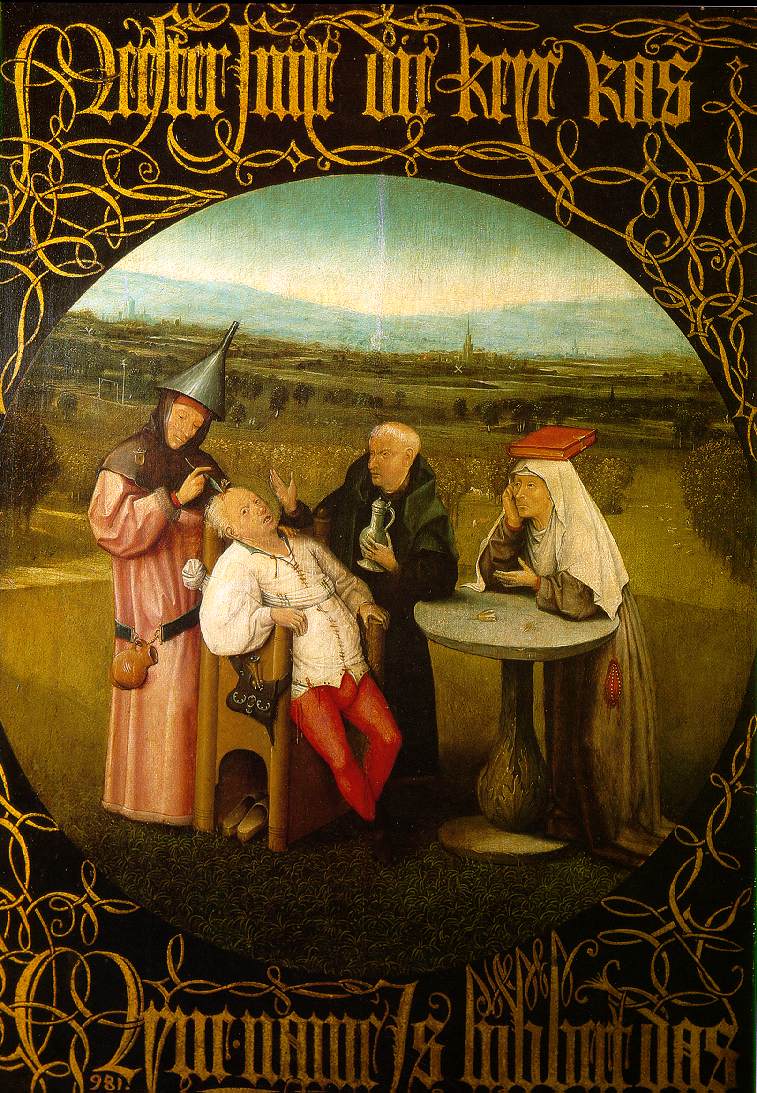
Bosch, The Cure of Folly, c. 1475-80
...and...

Descartes, 31 March 1596 – 11 February 1650

???

How to understand this? There is a discrepancy; either madness was or wasn't treated as an illness before Descartes posited it as such and the Age of Reason began in earnest.  Unless I am misunderstanding what I just read?? (entirely possible).

BTW, I loved seeing this painting in the Prado-- it made me wonder if it was meant to be funny... The book on the woman's head is curious... knowledge by osmosis.  The idea of Knowledge as disease would be humourous to me.  Standing next to someone who knows a lot about a lot and wondering if "is it contagious?"...  I suppose ppl who join organizations such as Mensa must face immense ostracism before meeting ppl who match their level of intelligence and/or knowledge.

Maybe Bosch was being ironic. Maybe he reckoned this man was only mad because he was allowing a charlatan to drill his skull.  The trials and trepanations of medieval science.  The "doc" doesn't look v sane... with that funnel on his unenlightened head.  Yes; my vote is the only sane person in the painting is the woman, looking utterly bored and leaning on that table as if to say "there is no cure for this stupidity...sigh." 

Wednesday, November 2, 2011

Distorted Perceptions

For many years, I've believed the way geography is taught in schools is not only counter-productive but actively misleading.
It is true that learning how the world is politically divided, how its borders came about, and what a topographical account looks like, it is as important to show the real size of different countries, once one has integrated and accepted this concept (of "countries") in the first place.

The only ways in which this can be done, according to me, is with numbers (area) or with maps.
I doubt many of us have any real idea of how big 30,000 square kilometers is in reality. I can't even be trusted to judge the dimensions of my windows in an accurate manner...
So maps become the best way to give us a glimpse of reality, inasmuch as that can happen when the subject is so vast and difficult to imagine.

Maps can be beautiful, too.  There are so many versions of a single account of an area, and that provides hours & hours of critical thought, and not only about geography, but about perception as a whole, how the same thing can be portrayed, and what could possibly be the motivation to show something in a specific way, and not in another.

Geography fascinates me because it can open the door to several topics of huge significance in the world.  Its apparent neutrality is also a positive, not only negative, feature of this discipline.  One doesn't feel like one is being indoctrinated or preached to when learning geography--- this can be dangerous, but because of its scientific properties (measurements etc), one can find out or demonstrate other points of view in an easier and less traumatic way, with fewer dogmatic obstacles, and end up reaching a far clearer understanding of the problems which exist in the world today-- political, with regards to population, natural resources, and relative importance each country may have on the chessboard of the various institutions with vague and long acronyms & abbreviations. I believe SCALE helps enormously when it comes to maps. I love them all, but when I look at a standard planisphere, it leaves me with the impression something is missing.

Today, my fav example of how one's point of view can shift and one's understanding expand in 5 seconds is this:


Since the African continent is so so SO often the topic of discussion about population, poverty, starvation, I should like to point out that the population of Africa is 1 billion ppl (2010), fewer than China alone, and with more natural resources.  This immediately makes me think its main problem, then, is not one of overpopulation.  Why aren't we told numbers like population density instead? 
So I go on and start looking for what might be the real problem(s)...

Geography is a v good starting point. One can end up anywhere from it.

Tuesday, November 1, 2011


Lookalikes

 
Martin Amis
Ney Matogrosso


Steve McQueen
Kevin Costner