Zizek
Foucault versus Derrida, or Foucault on Descartes
Cogito, madness and religion are interlinked in Descartes (génie malin), in Kant (distance from Swedenborg, who stands for madness, etc.) Simultaneously, Cogito emerges through differentiation from (reference to) madness, AND Cogito itself (the idea of Cogito as the point of absolute certainty, “subjective idealism”) is perceived (not only) by common sense as the very epitome of the madness of philosophy, crazy paranoiac system-building (philosopher as madman – (not only) late Wittgenstein). And, also simultaneously, religion (direct faith) is evoked as madness (Swedenborg for Kant, or radical Enlightenment rationalists, up to Dawkins), AND religion (God) enters as the solution from (solypsistic) madness (Descartes).
Foucault and Derrida: polemic, in which they share the key underlying premise: that Cogito is inherently related to madness. The difference: for Foucault,Cogito is grounded in the exclusion of madness, while, for Derrida, Cogito itself can only emerge through a “mad” hyperbole (universalized doubt), and remains marked by this excess. Before it stabilizes itself as res cogitans, the self-transparent thinking substance, Cogito as a crazy punctual excess.
In Foucault there is a fundamental change in the status of madness took place in the passage from Renaissance to the classical Age of Reason (the beginning of 17th century). In Renaissance (Cervantes, Shakespeare, Erasmus, etc.), madness was a specific phenomenon of human spirit which belonged to the series of prophets, possessed visionaries, those obsessed by demons, saints, comediants, etc. It was a meaningful phenomenon with a truth of its own. Even if madmen were vilified, they were treated with awe, like messengers of sacred horror. - With Descartes, however, madness is excluded: madness, in all its varieties, comes to occupy a position that was the former location of leprosy. It is no longer a phenomenon to be interpreted, searched for its meaning, but a simple illness to be treated under the well-regulated laws of a medicine or a science that is already sure of itself, sure that it cannot be mad. This change does not concern only theory, but social practice itself: from the Classical Age, madmen were interned, imprisoned in psychiatric hospitals, deprived of the full dignity of a human being, studied and controlled like a natural phenomenon.
In his Histoire de la folie, Foucault dedicated 3-4 pages to the passage in MEDITATIONS in which Descartes arrives at Cogito, ERGO SUM. Searching for the absolutely certain foundation of knowledge, Descartes analyses main forms of delusions: delusions of senses and sensible perception, illusions of madness, dreams. He ends with the most radical delusion imaginable, the hypothesis that all that we see is not true, but a universal dream, and illusion staged by an evil God (Malin Génie). From here, he arrives at the certainty of Cogito (I think): even if I can doubt everything, even if all I see is an illusion, I cannot doubt that I think all this, so Cogito is the absolutely certain starting point of philosophy. - Foucault’s reproach is that Descartes does not really confront madness, but avoids to think it. He EXCLUDES madness from the domain of reason: "Dreams or illusions are surmounted within the structure of truth; but madness is inadmissible for the doubting subject" In the Classical Age, Reason is thus based on the exclusion of madness: the very existence of the category 'madness' is historically determined, along with its opposite 'reason'; that is, it is determined, through power relations. Madness in the modern sense is not directly a phenomenon that we can observe, but a discursive construct which emerges at a certain historical moment, together with its double, Reason in the modern sense.
In his reading of Histoire de la folie, Derrida focused on these 4 pages about Descartes which, for him, provide the key to the entire book. Through a detailed analysis, he tries to demonstrate that Descartes does not EXCLUDE madness, but brings it to EXTREME: the universal doubt, where I suspect that the entire world is an illusion, is the strongest madness imaginable. Out of this universal doubt, Cogito emerges: even if everything is an illusion, I can still be sure that I think. Madness is thus not excluded by Cogito: it is not that the Cogito is not mad, but Cogito is true even if I am totally mad. The extreme doubt, the hypothesis of universal madness, is not external to philosophy, but strictly internal to it. It is the hyperbolic moment, the moment of madness, which GROUNDS philosophy. Of course, Descartes later “domesticates” this radical excess: he presents the image of man as thinking substance, dominated by reason; he constructs a philosophy which is clearly historically conditioned. But the excess, the hyperbole of universal madness, is not historical. It is the excessive moment which grounds philosophy, in all its historical forms. Madness is thus not excluded by philosophy: it is internal to it. Of course, every philosophy tries to control this excess, to repress it – but in repressing it, it represses its own innermost foundation: "Philosophy is perhaps the reassurance given against the anguish of being mad at the point of greatest proximity to madness"
I really enjoyed reading this text and need, must, get Foucault's History of Madness...
...but...
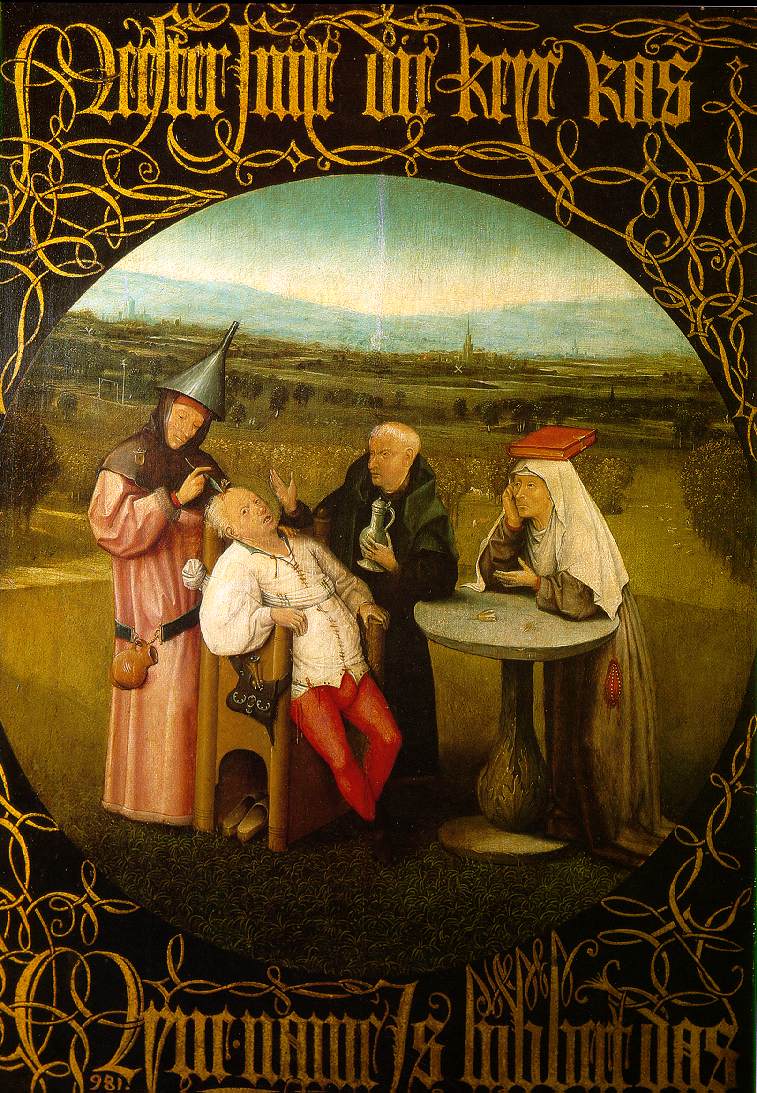 |
| Bosch, The Cure of Folly, c. 1475-80 |
...and...
Descartes, 31 March 1596 – 11 February 1650
???
How to understand this? There is a discrepancy; either madness was or wasn't treated as an illness before Descartes posited it as such and the Age of Reason began in earnest. Unless I am misunderstanding what I just read?? (entirely possible).
BTW, I loved seeing this painting in the Prado-- it made me wonder if it was meant to be funny... The book on the woman's head is curious... knowledge by osmosis. The idea of Knowledge as disease would be humourous to me. Standing next to someone who knows a lot about a lot and wondering if "is it contagious?"... I suppose ppl who join organizations such as Mensa must face immense ostracism before meeting ppl who match their level of intelligence and/or knowledge.
Maybe Bosch was being ironic. Maybe he reckoned this man was only mad because he was allowing a charlatan to drill his skull. The trials and trepanations of medieval science. The "doc" doesn't look v sane... with that funnel on his unenlightened head. Yes; my vote is the only sane person in the painting is the woman, looking utterly bored and leaning on that table as if to say "there is no cure for this stupidity...sigh."


