Cotidiano de uma brasileira em Paris, comentarios sobre cultura, politica e besteiras em geral. Entre le faible et le fort c'est la liberté qui opprime et la loi qui libère." Jean-Jacques Rousseau

Friday, April 5, 2013

DocuMentality


Adam Curtis - All Watched Over by Machines of Loving Grace 2/3 - The Use and Abuse of Vegetational Concepts


I've been watching his documentaries recently and finding them all of exceptional quality.  This episode is specially relevant.

Tuesday, February 26, 2013

GlobalEyes

Filho de imigrantes russos casado na Argentina com uma pintora judia, 
casou-se pela segunda vez com uma princesa africana no México.


Música hindú contrabandeada por ciganos poloneses faz sucesso no interior da Bolívia.


Zebras africanas e cangurus australianos no zoológico de Londres.


Múmias egípcias e artefatos incas no museu de Nova York.


Lanternas japonesas e chicletes americanos nos bazares coreanos de São Paulo.


Imagens de um vulcão nas Filipinas passam na rede de televisão em Moçambique.

~~


Armênios naturalizados no Chile procuram familiares na Etiópia.


Casas pré-fabricadas canadenses feitas com madeira colombiana. 


Multinacionais japonesas instalam empresas em Hong-Kong 
e produzem com matéria prima brasileira para competir no mercado americano.


Literatura grega adaptada para crianças chinesas da comunidade européia.

~


Relógios suíços falsificados no Paraguai vendidos por camelôs no bairro mexicano de Los Angeles.


Turista francesa fotografada semi-nua com o namorado árabe na baixada fluminense.


Filmes italianos dublados em inglês com legendas em espanhol nos cinemas da Turquia.


Pilhas americanas alimentam eletrodomésticos ingleses na Nova Guiné.


Gasolina árabe alimenta automóveis americanos na África do Sul.


Pizza italiana alimenta italianos na Itália.


Crianças iraquianas 
fugidas da guerra não obtém visto no consulado americano do Egito 


para entrarem na Disneylândia.


Titãs
Titanomaquia
1993
#Disneylândia

Monday, January 21, 2013

Idle Speculation


"Inertia is the resistance of any physical object to a change in its state of motion or rest, or the tendency of an object to resist any change in its motion. (…) Inertia comes from the Latin word, iners, meaning idle, or lazy." 

Thinking of this brought another word to mind, and I wondered about its possible correlation to the concept of negligence, not only in its legal definition but also in its broader application in social life.


Wednesday, January 16, 2013

I Am You...

Ricky Gervais

… tomorrow


Tony Haygarth as Ted Brooks, Inspector Morse, 1996


Tuesday, December 11, 2012

Of fence

“The hottest places in hell are reserved for those who, in times of great moral crisis, maintain their neutrality.” 

Dante Alighieri, Inferno

Friday, November 2, 2012

Bouche à Bouche (de métro)


Head to head
Face to face
Toe to toe
Mano-a-mano

But not:

Shoulder to shoulder
Tête-à-tête
Hand in hand
Eye to eye

Friday, October 26, 2012

iMmodesty Free


Just Keep Quiet and Nobody Will Notice

There is one thing that ought to be taught in all the colleges,
Which is that people ought to be taught not to go around always making apologies.
I don't mean the kind of apologies people make when they run over you or borrow five dollars or step on your feet,
Because I think that is sort of sweet;
No, I object to one kind of apology alone,
Which is when people spend their time and yours apologizing for everything they own.
You go to their house for a meal,
And they apologize because the anchovies aren't caviar or the partridge is veal;
They apologize privately for the crudeness of the other guests,
And they apologize publicly for their wife's housekeeping or their husband's jests;
If they give you a book by Dickens they apologize because it isn't by Scott,
And if they take you to the theater, they apologize for the acting and the dialogue and the plot;
They contain more milk of human kindness than the most capacious diary can,
But if you are from out of town they apologize for everything local and if you are a foreigner they apologize for everything American.
I dread these apologizers even as I am depicting them,
I shudder as I think of the hours that must be spent in contradicting them,
Because you are very rude if you let them emerge from an argument victorious,
And when they say something of theirs is awful, it is your duty to convince them politely that it is magnificent and glorious,
And what particularly bores me with them,
Is that half the time you have to politely contradict them when you rudely agree with them,
So I think there is one rule every host and hostess ought to keep with the comb and nail file and bicarbonate and aromatic spirits on a handy shelf,
Which is don't spoil the denouement by telling the guests everything is terrible, but let them have the thrill of finding it out for themselves. 
Ogden Nash

Saturday, September 29, 2012

I haven't slept for ten days, that would be too long.

'The starting point of a philosophical thought has to be the contingency of one's own language as the "substance" of one's own thinking: there is no direct path to universal truth through abstracting from the contingencies of one's "natural" tongue and constructing a new artificial or technical language whose terms would carry precise meanings.  This, however, does not mean that a thinker should naïvely rely on the resources of his own language: the starting point for his reflection should rather be the idiosyncrasies of his language, which are in a way redoubled contingencies, contingencies within a contingent (historically relative) order itself.  Paradoxically, the path from the contingency (of one's natural language) to the necessity (of speculative thought) leads through the redoubled contingency: one cannot escape thinking in one's language, this language is one's unsurpassable substance; however, thinking means thinking against the language in which one thinks -- language inevitably ossifies our thoughts, it is the medium of the fixed distinctions of Understanding par excellence.  But, while one has to think against the language in which one thinks, one has to do so within language, there is no other option.  This is why Hegel precludes the possibility (…) of purifying our natural language of its "irrational" contingencies and constructing a new artificial language that would faithfully reflect conceptual determinations.  Where, then, in language itself, can we find some support for thinking against it?  Hegel's answer is: where language is not a formal system, where language is at its most inconsistent, contingent, idiosyncratic.  The paradox is that one can only combat the "irrationality" of language on behalf of the immanent notional necessity if this necessity itself relies on what is most "irrational" in language, on its redoubled irrationality or contingency. (…)

What Hegel has in mind here is often uncannily close to Lacan's notion of lalangue: word-play, double meanings, and so on-- his great example in German are words with opposite or multiple meanings (like zu Grunde gehen, "disintegrate/fall apart" and, literally, "to go to, to reach, one's ground," etc., not to mention the notorious Aufhebung with its three meanings: to cancel/annihilate, to preserve, to elevate to a higher level).

(…)

There is no conceptual clarity without taking lalangue as a starting point -- (…)

Does not Freud intend something strictly homologous with his notion of symptoms, jokes, and slips of tongue?  An inner necessity can only articulate itself through the contingency of a symptom, and vice versa: this necessity (say, the constant urge of a repressed desire) comes to be only through this articulation.'

Zizek, Less Than Nothing, Hegel and the Shadow of Dialectical Materialism, pp. 470 - 71


Thursday, September 27, 2012

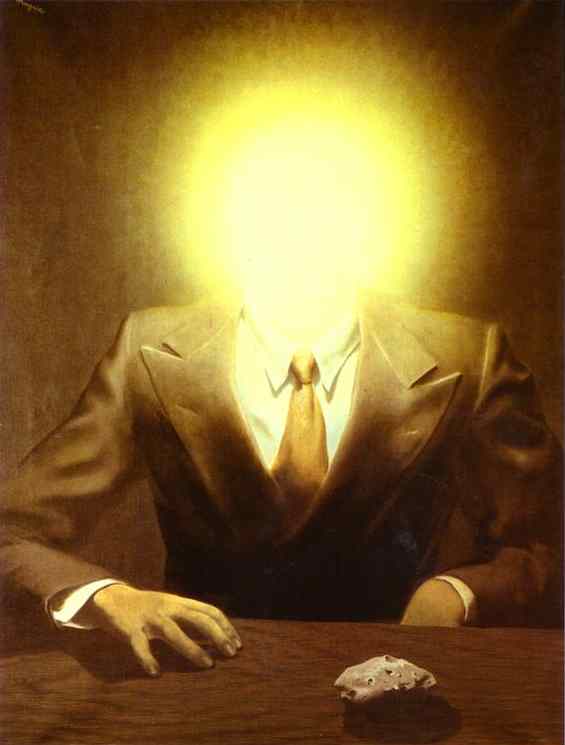
Magritte, Le Principle du Plaisir, 1937

Friday, September 7, 2012

BLacken Why?

I was thinking about reading/watching films last night.  For all the txts I've read, they helped me v little in terms of understanding images.  
The concepts and abstractions in an image, the ideas contained in them, yes, mos def, what's symbolized in some of them can be made clearer when one understands/absorbs them first through the written word (maybe).  

These past few days, after watching a couple of films in B&W, I've wondered why I've such trouble with it, and decided it isn't to do with its Idea. 

It is just harder for me to apprehend, understand and see, really, what B&W images depict in fim. It's a physical constraint.  Objects lose their immediately recognizable quality to me, in B&W, and I have to make a lot of effort to see what is there, even.  I find B&W works v v well for photos and film when the object depicted is a human being; faces, bodies, both. No problem there, at all. 


But when it is a scene in a room or outdoors, with a lot of "things" (tables, walls, trees, chairs, bottes...shelves; dresses, decor; even celestial bodies-- is it the moon? the sun?) not only do the things themselves become more difficult for me to identify, but what really requires my attn (and thus removes it from the narrative, from the art, from the dialogue- it 'kidnaps' my attn) is depth and perspective.  I lose most of my ability to see it at a glance.  


There are scenes I can barely "read" because of this. "Are they indoors? Outdoors? Is that a table or paint on wall? Chair or sculpture?  Is it the sky or the sea? Grass or sand? Are they standing on something? Are there stairs?  Is it daytime? Night?"  These details suck me out of the film proper and back into myself, my thoughts about the material world of objects, and the consciousness of my own thoughts about the scene/object(s) over which I'm puzzling.  


The mysterious pact between viewer and actor/director - a tacit understanding that that is fiction but it nevertheless manages to make the viewer "forget it" for the duration of the work (when it's good) - is interrupted, switched off.  


There are moments where B&W is better than colour.  


For instance, the one scene in the beginning of Stardust Memories by Woody Allen where ppl finally leave his flat, and he walks from the door toward the bookcase/bookshelf... on the big wall to the left, there's a blown-up photo of an Asian man with a gun pointed at his temple.  Here, I was truly impressed by the use and effect of B&W.  It highlighted the thing that needed to be highlighted, but also I suspect that photo is already in B&W anyway; if it is, this is a fun thought to me: the beauty of a B&W photo is made invisible by B&W.


What I dislike when watching a film is spending time thinking about what objects are and what colour they might be, and miss what the characters are saying/doing, and trying to figure out where they are, or if they're standing in the background or the foreground, etc etc. And I like B&W so much! the colours themselves, their juxtaposition!  I like it in animals, clothes, photographs, paintings, drawings, and I'd love few things better than a B&W Kaleidoscope.  


Up till colour in film was possible, there was no alternative.  Now there is, and I'd very much like to know what the justifications are for using it instead of colour, in commercial films.  I consider all films released in cinema commercial.  Films made to be shown only in museums are not commercial at inception, and usually do not tell a story in the sense of fictional narrative, so if theyre B&W it doesn't remove from the purpose of the film in the first place.  

Provocatively, the thought I'm left with is that contemporary commercial directors who use B&W in a film where the form doesn't require it for one reason or another, end up making anti-modern (AKA post-modern) films, rejecting stylistic and formal considerations, instead of adding to them.


Saturday, August 11, 2012

SeaSaw


Paul Nash, Winter Sea, 1925-1937


In York, England.  Saw this one yesterday at the York City Gallery, a surprising, small-ish museum with a few extremely good pieces.  In person, the one above is so beautiful it belongs in a room by itself.  

These two others were on the lower floor, housing an even more surprising combination of early Dutch religious paintings, taxidermy, and natures mortes.  The peacock ought to come with a caption saying "don't look at my feet", and if I were the curator, I'd call this juxtaposition HourGlasSkull "Time & Wind".
But what topped it all for me was seeing a painting by Jack Butler Yeats, brother of W.B., and not only was the painting quite good (I especially loved the colours) but the title is so unusual! That We May Never Meet Again depicts two friends who for whatever reason will never meet again!  I didn't know W. had a painter brother!  I won't post it, I didn't take a photo of it; just stood there and wondered about the title, and tried to ascertain how many different shades of blue were used, and if this was optimistic or not, and good thing there is a fan in this room cause it is so hot, and why haven't I heard of Jack Butler Yeats before... and I walked away thinking that no matter what the narrative may be, the painting is pretty good.

Thursday, August 2, 2012

If


IF you can keep your head when all about you 

Are losing theirs and blaming it on you,
If you can trust yourself when all men doubt you,
But make allowance for their doubting too;
If you can wait and not be tired by waiting,
Or being lied about, don't deal in lies,
Or being hated, don't give way to hating,
And yet don't look too good, nor talk too wise:


If you can dream - and not make dreams your master;
If you can think - and not make thoughts your aim;
If you can meet with Triumph and Disaster
And treat those two impostors just the same;
If you can bear to hear the truth you've spoken
Twisted by knaves to make a trap for fools,
Or watch the things you gave your life to, broken,
And stoop and build 'em up with worn-out tools:


If you can make one heap of all your winnings 
And risk it on one turn of pitch-and-toss,
And lose, and start again at your beginnings
And never breathe a word about your loss;
If you can force your heart and nerve and sinew
To serve your turn long after they are gone,
And so hold on when there is nothing in you
Except the Will which says to them: 'Hold on!'


If you can talk with crowds and keep your virtue,
' Or walk with Kings - nor lose the common touch,
if neither foes nor loving friends can hurt you,
If all men count with you, but none too much;
If you can fill the unforgiving minute
With sixty seconds' worth of distance run,
Yours is the Earth and everything that's in it,
And - which is more - you'll be a Man, my son!


Kipling

Tuesday, July 24, 2012

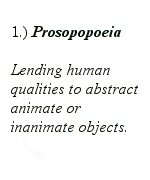
Prosopomp & Circumvent


e.g. "The markets received encouraging news in regards to the European debt crisis, the Fed extended "operation twist" and commodity prices continued to trend ..."


Wednesday, June 20, 2012

Dickinson


XI
MUCH madness is divinest sense
To a discerning eye;
Much sense the starkest madness.
’T is the majority
In this, as all, prevails.        
Assent, and you are sane;
Demur,—you ’re straightway dangerous,
And handled with a chain.