Cotidiano de uma brasileira em Paris, comentarios sobre cultura, politica e besteiras em geral. Entre le faible et le fort c'est la liberté qui opprime et la loi qui libère." Jean-Jacques Rousseau

Showing posts with label madness. Show all posts

Wednesday, February 8, 2012

My generation is so sad.  My generation has no link, no connection to what went on before it; we're loose bits of rocket released in the vacuum of space, without even knowing we were once part of the rocket.  We've no intellectual home, no emotional link to our predecessors; no idea or ethos binds us together as a group or in opposition to another group.  The generations which come later are even worse.  No will to LIVE, no incentive; no goal has been identified, no philosophy has come out of it, and these are the yrs when vigorous rebellion is easiest, when hormones and unapologetic arrogance not yet earned are at its peak.

Technology has never been more advanced -- (btw, what kind of stupid phrase is this anyway? Of COURSE technology can only become more and more advanced as a linear conception of time follows its course! but I digress) -- and ppl have seldom been this illiterate.  
Not even in a traditional way. 

Ppl know other forms of knowledge and literacy to the ones I knew at, say, age 20. But the problem is the lack of connection with everything else.

How is one to measure progress if the body of work produced by Man so far is no longer acknowledged -- not even known!
Are we about to witness 3, 4 generations studying like mad only to reinvent the wheel? Out of sheer ignorance?
What ARE they studying?  Theyre not reading the classics, theyre not studying political or economic theory; theyre not studying philosophy or fine arts.  They've no clue how language and History connect, no idea about the extent to which language itself influences ALL disciplines and how theyre formulated, posited, and directed.  And if *I* am saying this the problem is grave, friends, because I'm hardly a polymath.

Were I Dictator of the Polyverse, my first decree would be that an introduction to metalinguistics be made compulsory in formal education at age FIFTEEN.  "These are the tools used in order to steer ppl's thoughts THAT way instead of any other way it could have gone."  In all disciplines!  From scientific discourse all the way down to softer disciplines which teach ppl v little (i.e. pedagogy).

Reductionist views of the human person and what s/he can accomplish, why, and how, effectively removes the infinite potential we all have in us to create or rearrange what already exists.  This does come from a sloppy and misguided conception of language and how it shapes thought.  
The idea that something is only real and true once it has been proven by science, using the scientific method as it is today, is so destructive even of science that I am perplexed flabbergasted incandescent, plus which baffled as well as fascinated by the fact ppl don't see it, don't discuss it, and scientists themselves do not address it.

Because if the v nature and foundation of the scientific method is by definition an endless process whereby epistemology is a work in eternal progress (with perhaps the exception of some elements of biology and physics), then why should A Scientific Discovery be considered as a more final, solid, reliable truth than any other got via another epistemological field?  

If science is never done, if the scientific inquiry itself is always being perfected and its accepted truths challenged (necessarily), then surely it is AS reliable as any other type of knowledge.

But everything is not about science and how some of its tenets have been misapplied and misinterpreted.

The problem is a lot more serious.  I see these 20somethings walking around as if they've already died, not unlike the zombies they spend so much time attempting to kill in videogames.  There is no joy on their faces, no understanding of the beauty lying there, created by countless generations before them.  They know technology intimately, and think that because their grandparents couldn't operate a computer or a videogame, they were less intelligent, less capable, more naive.  In reality it is the v opposite.  

When one opens a BOOK, a dictionary, one doesn't only learn what one was looking for. When one looks for one word in the dictionary, one ends up seeing many others, and learning what those other words mean, too.  

Analog absorption of knowledge is more complete, more thorough, more vast, if yes slower.
But learning by analogy, identifying analogous elements in the world is far more important than knowing WHERE to click on a computer screen.

In my own circle, I have noticed how more and more ppl have difficulty identifying rather unimpressive, common, symbols, which anyone who grew up in a certain culture ought to be able to discern; ppl can't speak metaphorically anymore.  

The paradoxical element of metaphorical language is that because of its seeming vagueness and potential for misunderstanding, ppl apply their intellectual ability a lot more!  When an idea is conveyed in non-metaphorical language, the words used to convey it had better be pretty well-chosen, pretty accurate, for the interlocutor will not think twice. And this is tragic when linguistic knowledge has either not been ingested or has been poorly digested.
Metaphors HELP us think.  They help us think more, and better, and in different ways.
Symbols do, too.

But these elements are scarcer & scarcer in daily speech and, worse, in literature & in art!! The v womb of metaphors&symbols. This womb is now an inhospitable one, to match the general sterility of the average 20-something, plucked and clean, straight and falsely serious.  No! They're not even serious! I'm wrong!  They're DULL.

Instead of metaphors and symbols we get avatars and txt msg lingo.  At the HEIGHT of freedom, we choose to put ourselves in a prison of ignorance.  At a time when we could have the most knowledge about any and everything that's already been created, we choose instead to make our "knowledge" narrower and narrower, about things which are finite, and whose application is limited, and in the service and for the benefit of those whose interest is to keep us ignorant and disconnected, atomized, lost, depressed, drugged, surrounded by machines and meaningless objects, buying, buying, more&more, to dull the senses, distract the mind, lose focus; anything but see that we're running around in squares.  Yes squares!  My God 20somethings these days are square in the worst possible way!  Get married quickquick, have kids, get mortgage oweowe bucketsful of money to banks, to schools, quickquick, indebted youth has no time to think, they have to workwork get job makepayment every month!

This entry's organization is a reflection of the topic treated here.

I trust Mankind's potential.  I believe curiosity will prevail, even if at times it looks unlikely.

Today's young... the younger they look the older and more hopeless they are inside.  I wish that they,  like me, may become younger, the older they look.

Wednesday, January 25, 2012

PlaTonic

The discussion that day was about loss of self, about Plato's four divine madnesses, about madness of all sorts; he began by talking about what he called the burden of the self, and why people want to lose the self in the first place.


"Why does that obstinate little voice in our heads torment us so?" he said, looking round the table.  "Could it be because it reminds us that we are alive, of our mortality, of our individual souls--which, after all, we are too afraid to surrender but yet make us feel more miserable than any other thing?  But isn't it also pain that often makes us most aware of the self?  It is a terrible thing to learn as a child that one is a being separate from all the world, that no one and no thing hurts along with one's burned tongues and skinned knees, that one's aches and pains are all one's own.  Even more terrible, as we grow older, to learn that no person, no matter how beloved, can ever truly understand us.  Our own selves make us most unhappy, and that's why we're so anxious to lose them, don't you think?  Remember the Erinyes?"

"The Furies," said Bunny, his eyes dazzled and lost beneath the bang of hair.

"Exactly.  And how did they drive people mad?  They turned up the volume of the inner monologue, magnified qualities already present to great excess, made people so much themselves that they couldn't stand it. ..."
Donna Tartt, The Secret History, p. 32


Socrates' speech begins by sorting out the category of mania. Madness comes in two general forms: the diseased state of mental dysfunction, and a divergence from ordinary rationality that a god sometimes brings (see 265a–b). Divine madness in turn takes different forms: love, Dionysian frenzy, oracular prophecy, and poetic composition (244b–245a). In all four cases the possessed or inspired person (enthousiazôn: 241e, 249e, 253a, 263d) can accomplish what is impossible for someone in a sane state. All four cases are associated with particular deities and traditionally honored.

Thursday, November 3, 2011

Zizek


Foucault versus Derrida, or Foucault on Descartes


Cogito, madness and religion are interlinked in Descartes (génie malin), in Kant (distance from Swedenborg, who stands for madness, etc.) Simultaneously, Cogito emerges through differentiation from (reference to) madness, AND Cogito itself (the idea of Cogito as the point of absolute certainty, “subjective idealism”) is perceived (not only) by common sense as the very epitome of the madness of philosophy, crazy paranoiac system-building (philosopher as madman – (not only) late Wittgenstein). And, also simultaneously, religion (direct faith) is evoked as madness (Swedenborg for Kant, or radical Enlightenment rationalists, up to Dawkins), AND religion (God) enters as the solution from (solypsistic) madness (Descartes).

Foucault and Derrida: polemic, in which they share the key underlying premise: that Cogito is inherently related to madness. The difference: for Foucault,Cogito is grounded in the exclusion of madness, while, for Derrida, Cogito itself can only emerge through a “mad” hyperbole (universalized doubt), and remains marked by this excess. Before it stabilizes itself as res cogitans, the self-transparent thinking substance, Cogito as a crazy punctual excess. 

In Foucault there is a fundamental change in the status of madness took place in the passage from Renaissance to the classical Age of Reason (the beginning of 17th century). In Renaissance (Cervantes, Shakespeare, Erasmus, etc.), madness was a specific phenomenon of human spirit which belonged to the series of prophets, possessed visionaries, those obsessed by demons, saints, comediants, etc. It was a meaningful phenomenon with a truth of its own. Even if madmen were vilified, they were treated with awe, like messengers of sacred horror. - With Descartes, however, madness is excluded: madness, in all its varieties, comes to occupy a position that was the former location of leprosy. It is no longer a phenomenon to be interpreted, searched for its meaning, but a simple illness to be treated under the well-regulated laws of a medicine or a science that is already sure of itself, sure that it cannot be mad. This change does not concern only theory, but social practice itself: from the Classical Age, madmen were interned, imprisoned in psychiatric hospitals, deprived of the full dignity of a human being, studied and controlled like a natural phenomenon.

In his Histoire de la folie, Foucault dedicated 3-4 pages to the passage in MEDITATIONS in which Descartes arrives at Cogito, ERGO SUM. Searching for the absolutely certain foundation of knowledge, Descartes analyses main forms of delusions: delusions of senses and sensible perception, illusions of madness, dreams. He ends with the most radical delusion imaginable, the hypothesis that all that we see is not true, but a universal dream, and illusion staged by an evil God (Malin Génie). From here, he arrives at the certainty of Cogito (I think): even if I can doubt everything, even if all I see is an illusion, I cannot doubt that I think all this, so Cogito is the absolutely certain starting point of philosophy. - Foucault’s reproach is that Descartes does not really confront madness, but avoids to think it. He EXCLUDES madness from the domain of reason: "Dreams or illusions are surmounted within the structure of truth; but madness is inadmissible for the doubting subject" In the Classical Age, Reason is thus based on the exclusion of madness: the very existence of the category 'madness' is historically determined, along with its opposite 'reason'; that is, it is determined, through power relations. Madness in the modern sense is not directly a phenomenon that we can observe, but a discursive construct which emerges at a certain historical moment, together with its double, Reason in the modern sense.

In his reading of Histoire de la folie, Derrida focused on these 4 pages about Descartes which, for him, provide the key to the entire book. Through a detailed analysis, he tries to demonstrate that Descartes does not EXCLUDE madness, but brings it to EXTREME: the universal doubt, where I suspect that the entire world is an illusion, is the strongest madness imaginable. Out of this universal doubt, Cogito emerges: even if everything is an illusion, I can still be sure that I think. Madness is thus not excluded by Cogito: it is not that the Cogito is not mad, but Cogito is true even if I am totally mad. The extreme doubt, the hypothesis of universal madness, is not external to philosophy, but strictly internal to it. It is the hyperbolic moment, the moment of madness, which GROUNDS philosophy. Of course, Descartes later “domesticates” this radical excess: he presents the image of man as thinking substance, dominated by reason; he constructs a philosophy which is clearly historically conditioned. But the excess, the hyperbole of universal madness, is not historical. It is the excessive moment which grounds philosophy, in all its historical forms. Madness is thus not excluded by philosophy: it is internal to it. Of course, every philosophy tries to control this excess, to repress it – but in repressing it, it represses its own innermost foundation: "Philosophy is perhaps the reassurance given against the anguish of being mad at the point of greatest proximity to madness" 

I really enjoyed reading this text and need, must, get Foucault's History of Madness...

...but...


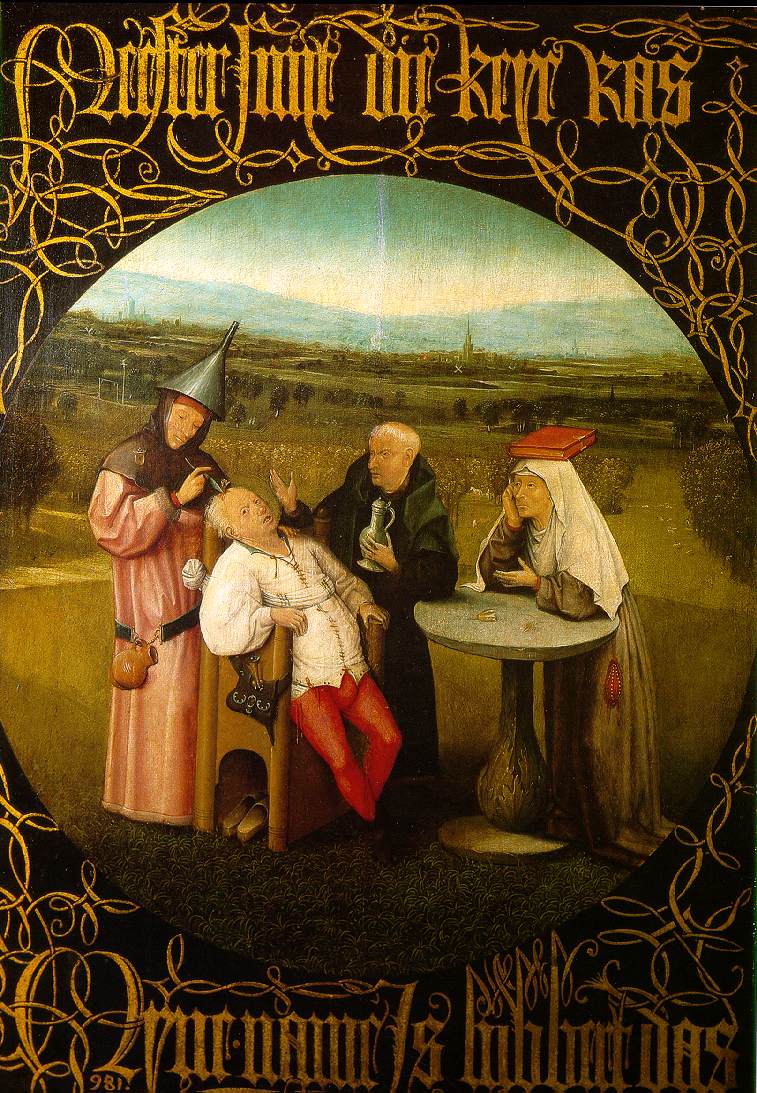
Bosch, The Cure of Folly, c. 1475-80
...and...

Descartes, 31 March 1596 – 11 February 1650

???

How to understand this? There is a discrepancy; either madness was or wasn't treated as an illness before Descartes posited it as such and the Age of Reason began in earnest.  Unless I am misunderstanding what I just read?? (entirely possible).

BTW, I loved seeing this painting in the Prado-- it made me wonder if it was meant to be funny... The book on the woman's head is curious... knowledge by osmosis.  The idea of Knowledge as disease would be humourous to me.  Standing next to someone who knows a lot about a lot and wondering if "is it contagious?"...  I suppose ppl who join organizations such as Mensa must face immense ostracism before meeting ppl who match their level of intelligence and/or knowledge.

Maybe Bosch was being ironic. Maybe he reckoned this man was only mad because he was allowing a charlatan to drill his skull.  The trials and trepanations of medieval science.  The "doc" doesn't look v sane... with that funnel on his unenlightened head.  Yes; my vote is the only sane person in the painting is the woman, looking utterly bored and leaning on that table as if to say "there is no cure for this stupidity...sigh."